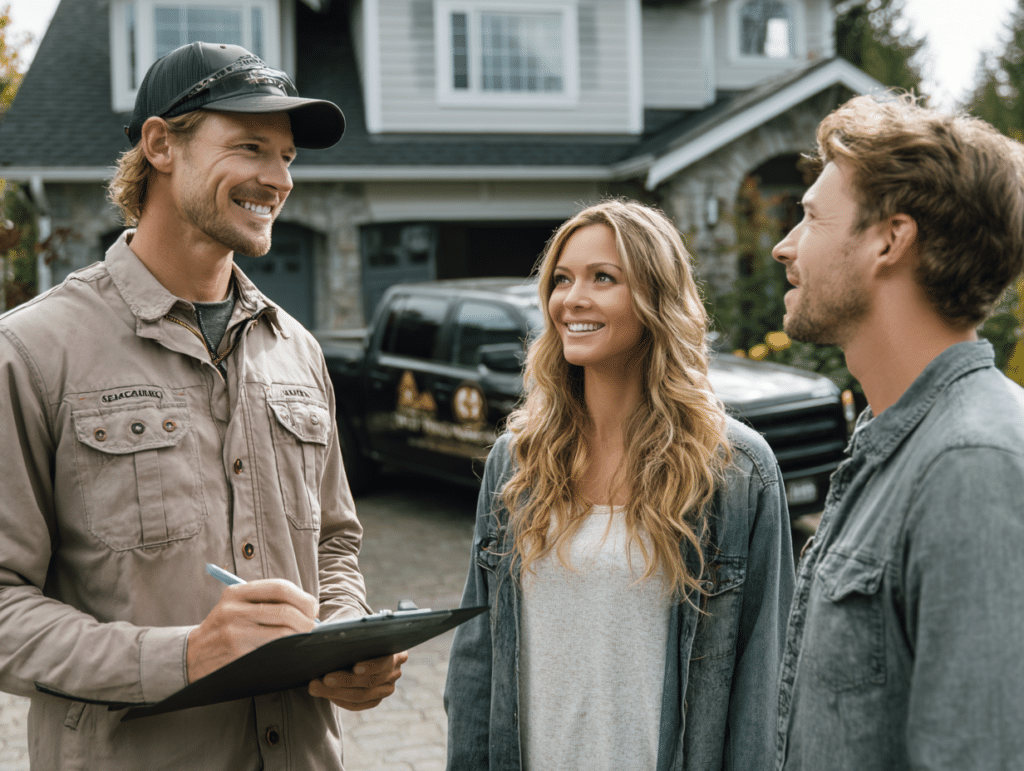
Hiring a roofing contractor is one of the bigger decisions you will make as a homeowner. Get it right, and you have a solid roof, backed by good warranties, installed by people who stand behind their work. Get it wrong, and the consequences can range from annoying to financially significant.
The challenge is that most homeowners only go through this process once or twice in a lifetime. You do not have the experience of hiring dozens of contractors to draw on. And the roofing industry has more than its share of operations that know how to look legitimate without actually being so.
This guide covers what to look for, what to ask, and what warning signs to take seriously when evaluating roofing contractors in Western North Carolina.
Start with Licensing and Insurance
This is not optional and not negotiable. Every roofing contractor working in North Carolina must hold an appropriate contractor’s license. Depending on the scope of work, this may be a general contractor’s license or a specialty contractor’s license. You can verify license status through the North Carolina Licensing Board for General Contractors.
Insurance is equally non-negotiable. At minimum, a roofing contractor should carry:
General liability insurance: Covers property damage that might occur during the job, like a worker accidentally damaging your vehicle or siding.
Workers’ compensation insurance: Covers medical costs and lost wages if a worker is injured on your property. Without this, you could be liable for a worker’s injuries that happen on your roof.
Ask for certificates of insurance before any work begins, and confirm that the coverage amounts are adequate. A reputable contractor provides this without hesitation. Any contractor who is reluctant to produce insurance documentation is telling you something important.
Local Presence and Track Record
There is a meaningful difference between a contractor who is established in your community and one who is passing through. A locally-owned business has a reputation to protect with your neighbors, your community, and the local business environment it operates in every day. When something does not go as planned, a local contractor has an incentive to make it right. A company with no local roots has less at stake.
Look for signs of genuine local establishment:
Physical address that you can verify (not just a P.O. box)
Consistent service history in your specific area
References from other homeowners in the region
Active presence on local review platforms (Google Business, Better Business Bureau, Angi)
The length of time in business matters too. A company that has been serving the Asheville and Western NC area for a decade or more has navigated enough seasons, enough storms, and enough challenging projects to know what they are doing.
Check Reviews Carefully
Online reviews are genuinely useful, but they require some discernment.
Look for volume as much as score. A contractor with 300 reviews averaging 4.6 stars tells you more than one with 12 reviews at 5 stars. Look at how long the reviews span. Are they recent? Are they from the same time period, which could indicate a coordinated review push?
Read the negative reviews. How the company responded to unhappy customers is often more revealing than the review itself. A contractor who engages respectfully with criticism, acknowledges the issue, and offers to make it right demonstrates accountability. One who becomes defensive or attacks the reviewer is showing you what to expect if your project hits a problem.
Look for specific details in positive reviews. Vague “great service!” reviews are less informative than ones that describe the project scope, what went well, and how the contractor communicated. Reviews that mention specific crew members or project details are harder to fabricate.
Get Multiple Estimates
For any significant roofing project, getting at least two or three estimates is sensible. This is not primarily about finding the lowest price. It is about having enough information to evaluate what you are being offered.
Estimates that cover the same scope give you a basis for comparison. If one estimate is significantly lower than others, that is worth investigating rather than celebrating. Very low prices usually mean one of a few things: lower-quality materials, a plan to cut corners on installation, inadequate labor, or a contractor who plans to collect a deposit and disappear.
An estimate should be detailed and in writing. It should specify materials by name and grade, describe the scope of work clearly, and outline what is included in the price (tear-off, disposal, cleanup, permits). A verbal estimate or a one-line number on a napkin is not something you can hold anyone accountable to.
Ask About Manufacturer Certifications
Roofing material manufacturers like GAF maintain contractor certification programs that recognize contractors who meet specific standards for licensing, insurance, training, and installation quality. GAF’s Master Elite certification, the company’s top tier, is held by only about 3 percent of roofing contractors nationally.
This matters practically because manufacturer warranty coverage is often tied to whether your contractor is certified. A Master Elite GAF contractor can offer warranty options, including the GAF Golden Pledge warranty, that a non-certified contractor cannot. If long-term warranty coverage is a priority for you, verifying your contractor’s certification status is worth doing.
Secure Roofing holds GAF Master Elite certification. It is one of the reasons our customers have access to the strongest available warranty coverage on GAF products.
Evaluate the Communication and Process
Pay attention to how a contractor communicates from the first contact through the estimate process. This early interaction tells you a great deal about what the working relationship will look like.
A contractor worth hiring will:
Show up when they say they will for the inspection
Explain their findings clearly and without unnecessary alarm
Present options rather than a single this-or-nothing proposal
Answer your questions directly and without dismissiveness
Provide a clear written estimate without pressure to sign immediately
Be transparent about the project timeline
A contractor worth avoiding will:
Create urgency to sign before you have had time to consider
Be vague about materials, process, or what is included in the price
Show up significantly late or not at all for the inspection
Pressure you to pay a large deposit upfront before any work is scheduled
The consultation and estimate process is a preview of how you will be treated throughout the project. Take it seriously.
Understand the Contract Before Signing
A proper roofing contract specifies:
The full scope of work, including what is being removed, what is being installed, and what brand and grade of materials
The payment schedule (a reasonable deposit is normal; paying in full before work begins is not)
The project timeline and start date
The workmanship warranty terms
Who is responsible for permits
What happens if additional damage is found during tear-off
Do not sign anything that contains blanks to be filled in later, that you have not read fully, or that omits the items above. A contractor who resists putting things in writing is a contractor who intends to have flexibility at your expense.
Frequently Asked Questions
Should I hire a contractor who approaches me after a storm?
Be cautious. While some legitimate contractors do outreach after major weather events, storm-chasing operations that move through affected areas are a real problem. Verify any contractor’s local credentials, license status, and insurance before engaging. A contractor who pressures you to sign immediately or asks you to sign over your insurance benefits is a serious red flag.
Is it worth paying more for a certified contractor?
For most homeowners, yes. The warranty access, the assurance that the installation meets manufacturer specifications, and the accountability that comes with a contractor who has earned and maintains a certification all provide real value. The price difference is often smaller than homeowners expect.
How large of a deposit is normal to pay upfront?
Deposits of 10 to 30 percent are within normal range for roofing projects. Requests for 50 percent or more upfront, or for full payment before work begins, are outside normal practice. Pay the final balance only after the work is complete and you have done a walkthrough.
How do I check a contractor’s license status in North Carolina?
The North Carolina Licensing Board for General Contractors maintains an online database where you can search by company name or license number. South Carolina has a similar resource through the South Carolina Contractor’s Licensing Board. Verifying license status takes a few minutes and is worth doing before any conversation gets serious.
What if the contractor damages something on my property during the job?
This is why general liability insurance is essential. Document any property damage that occurs during the project, notify the contractor immediately, and file a claim through their liability insurance if needed. This is a standard process, and a properly insured contractor will have no issue with it.
Choosing With Confidence
The right roofing contractor is licensed, insured, locally established, communicates clearly, provides detailed written estimates, and backs their work with a solid warranty. None of those criteria are difficult to verify. Taking the time to do so before signing anything is the most reliable protection you have.
If you are evaluating roofing contractors in Asheville, Hendersonville, Black Mountain, Brevard, Fletcher, or anywhere across Western North Carolina and the South Carolina upstate, we welcome the opportunity to be part of that process. We are locally owned, GAF Master Elite certified, licensed and insured, and we start every project with a free, no-obligation estimate.
Contact Secure Roofing to schedule your consultation, or call 828-888-ROOF. You can learn more about who we are and how we work on our About Us page.
Schedule OurService
Our Services
Contact Our Roofing Team
Ask Secure Roofing today for an appointment. Call us or fill out the form to get started.